Total Pageviews are you looking

Translate traducir 翻譯 翻訳する แปลง переводить übersetzen traduire

Tuesday, May 1, 2012

Carnivorous Plants: Hungry & Gorgeous

Passive-Aggressive, Green and Very Hungry!

You have to admit, it does make a kind of twisted sense: After all, we've been feasting on their fibrous, nutrition-packed stems, leaves, tubers, and fruits since we began to actually eat the salad that came with our steaks so, naturally, there must have been a certain ... well, 'desire' for reciprocity. In other words if we eat them why shouldn't they want to eat us?


(images via)

For all you geeks out there – and, yes, we know who you are – it's commonly thought that the first depiction of a salad making a meal out of a man comes from Dr. Carl Liche, writing in 1881. J.W. Buel echoed the idea in his Land and Sea in 1887 (see below). Unluckily for Liche and Buel they've been since exposed as 'imaginative' instead of 'accurate.' ("The Day of the Triffids" by John Wyndham also deserves a mention). Hate to disappoint but true man-eating plants are a total myth:
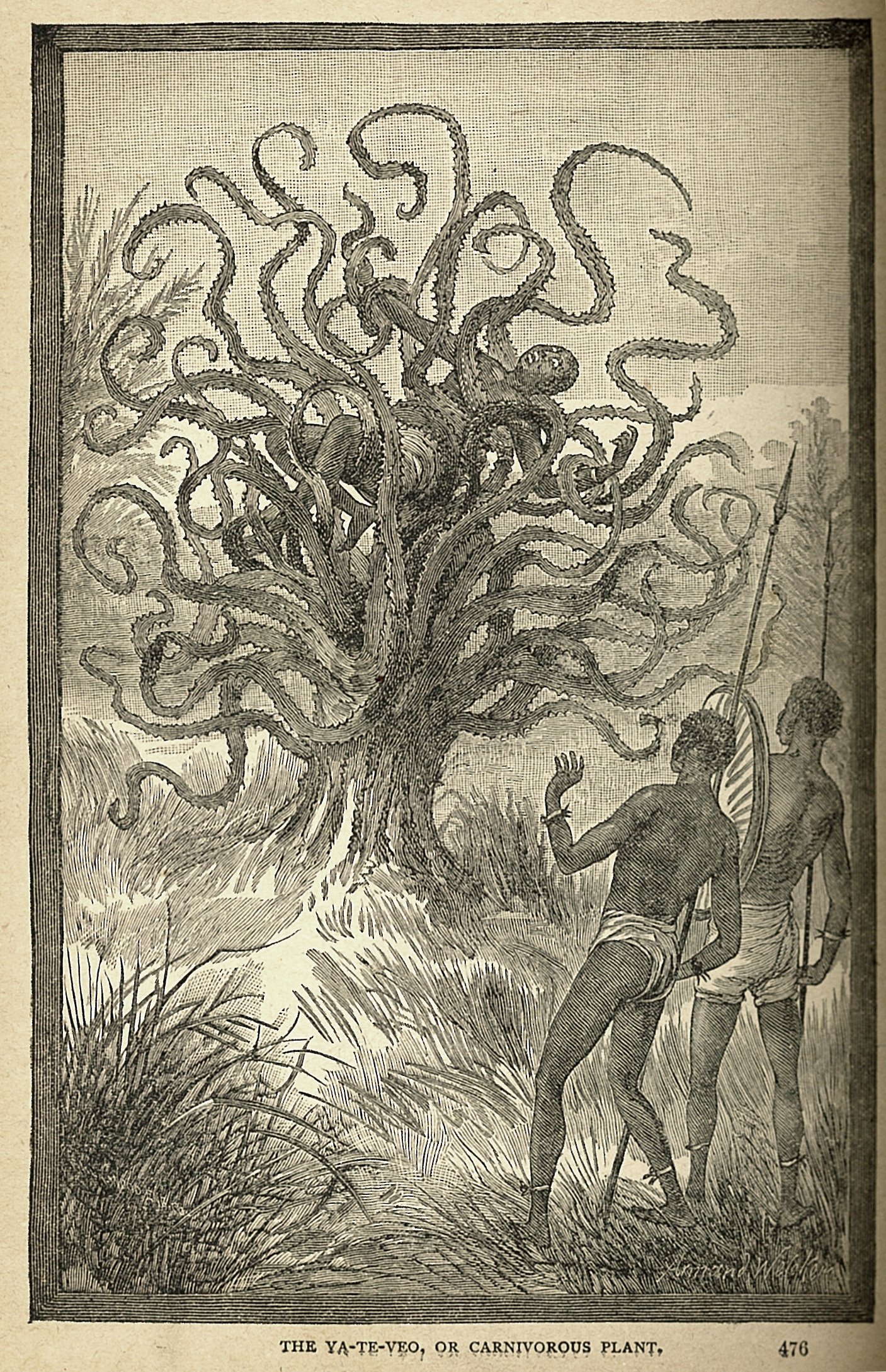

(image via, click to enlarge)

But that doesn't mean that the next time you sit down to feast on a supposedly defenseless potato there aren't other forms of plant life that are also having a tasty meal of, while not us humans, then most definitely other animals – and sometimes rather large animals. 


(images credit: Barry Rice, 2)

Venus Entrapment

The poster-plant for botanical carnivores has got to be the legendary Venus Flytrap. A resident of swamps and bogs, the flytrap has evolved a dramatic solution to its lack-of-nutrient diet: it catches flies – and pretty much anything big enough to get caught. 


(left via; right image credit: Karoshi) 

What's amazing about this plant is its mechanism. Anything that happens to stumble between the two halves of its unique mechanism will find itself in caught in a quickly-snapping-shut botanical bear trap. What's even worse is that after being caught the Venus then fuses those leaves together, turning them into a kind of stomach to digest its prey. What's extra-fascinating is that the trap has two triggers, and that both of them have to be tripped for the leaves to snap shut, to avoid misfires.


(image via)

Alluring Perfume in a Deadly Pitcher

While the flytrap looks like something out of a monster movie it rarely grows to any really impressive size – unless you happen to be a housefly. But one carnivorous plant that really is impressive, and recently discovered, is what's called a passive hunter. Instead of using snapping traps its family instead has evolved fluid-filled pitfalls lined with very slippery sides, and baited with a very alluring perfume. 


(right: Sarracenia hybrid - images credit: Helene Schmitz, National Geographic)

Pitcher plants come in a wide variety of shapes, types, and sizes – including a special one native to the Philippines. Most pitchers feast on bugs and sometimes small lizards: pretty much whatever's unfortunate enough to get seduced by the plant's alluring smells and is small enough to fit down its leafy throat. While its mechanism is similar to its smaller kin, nepenthes attenboroughii (named after journalist and TV presenter David Attenborough), has traps that are large enough to catch not only bugs, lizards, and – what's more than a bit scary – rats (more info). 


(images via 1, 2)


(image credit: Caroling)


(images credit: Shatalkin)

A Cobra Lily

"A pale green butterfly senses nectar and alights on a rare California pitcher plant. Also called a cobra lily for its bulbous head, forked tongue, and long tubular pitcher, it grows in mountainous parts of the West Coast and is an oddity among its kind. Although it traps prey in a manner similar to other pitcher plants, its leaves contain no digestive enzymes. Instead, it relies on symbiotic bacteria to turn captured insects into usable nutrients." (see the whole gallery).


(left: Cobra Lily; right: Nepenthes lowii - images credit: Helene Schmitz, National Geographic)


(image credit: Noah Elhardt)

Pretty, Pretty Sundew

Another device carnivorous plants use is to make its prey stick around long enough to be digested. The sundew, for instance, has leaves covered with dozens of tiny stalks, and each stalk is covered with very, very, very sticky stuff. When a bug happens to walk across these leaves it gets – you guessed it – very, very, very stuck. What's more, though, is that the plant then contracts, bringing more and more of those stalks into contact with its prey, completely trapping and then digesting it:


(images credit: Helene Schmitz, National Geographic)


(images via 1, 2)

Here is a great video depicting the "War between Carnivorous Plants and Herbivorous insects" - YouTube link.


(image credit: Olga Sytina)

Enter the Kudzilla!

But then there's the other, the monster, the beast, the chlorophyll creature that could – if any plant could be – considered a bona fide killer. Innocently imported to the US in 1876 from its native Japan, it was sold as a botanical miracle: ink, paper, jelly, tea, you name it and you could make it from this wonderful plant. But what no one could expect that this so-called marvel would have darker roots.


(image credit: MissyPrince)


(image credit: Patrick Walker)

Kudzu is its name and right now it covers – in some cases quite literally – a huge part of the Southeastern United States. While bamboo is a racehorse at two foot a day, Kudzu is hardly a slacker at covering half that distance in the same amount of time. In the South there are homes, cars, houses and entire communities that have been hungrily, potentially, covered – and subsequently strangled – by this ferociously determined plant. 


(images via 1, 2, 3, 4)


(image credit: Kyle Telechan)

Sure, kudzu may not be carnivorous, but it's green infestation, it's emerald conquest, it's verdant domination is definitely worth a mention – and maybe a serious shudder of fear. Or, as they sometime say in the South: "A cow won't eat kudzu, but kudzu will definitely eat a cow."


(image credit: Josh Sommers)

Impossible Plant-Animal Hybrid

Wildly bizarre half-plant/half-animal creature - with a lovely name "Eastern Emerald Elysia"

This beautiful leaf-shaped sea slug Elysia chlorotica lives in shallow pools along Atlantic coast of North America, eats algae with gusto - one meal is enough for its lifetime! - and by using photosynthesis like any other plant, shatters the most basic definition between the "animal" and "plant" kingdoms.

(images credit: PNAS, via, Nicholas E. Curtis and Ray Martinez, via)

It may not be "easy being green", but for this slug it turned out to be highly efficient!


This is the ONLY natural example of genes shared between the living kingdoms of "plants" and "animals"

Shaped like a leaf? Check. Totally colored green? Check, although the young slugs are still colored brown until they eat their first "green" meal... but right after that, they're ready to make pigment chlorophyll a all by themselves for the rest of their lives!

One thing about Elysia chlorotica, "a sea slug that has stolen enough genes to become the first animal shown to make chlorophyll like a plant" (via)... They don't just use chloroplasts from the algae they eat - this phenomenon, though rare, is known as kleptoplasty. What's more, they seem to have the particular genes that make them able to keep processing these chloroplasts in a consistent and sustainable way:


What sort of surprises can be found in a humble shallow pool? Turns out, quite an awful lot! Elysia chlorotica likes to inhabit "salt marshes, tidal marshes, pools and shallow creeks, at depths of 0 m to 0.5 m". All this should serve as a good encouragement to look closer into swamps and marshes (provided they are not haunted by any mad scientist apparitions, or the feral Hounds of the Baskervilles). There is positively astonishing microscopic biodiversity to be discovered all around your feet!

(images credit: Patrick Krug, Discover Magazine)


Talk about true "slacker" of the animal kingdom!

Consider Elysia chlorotica: when it comes to consuming chloroplasts, one slurping is enough! "It's the ultimate form of solar power: eat a plant ONCE, become photosynthetic for the rest of your life":

Watch the video here of its feeding off the algae (very appetizing!).


"When it munches on its favorite food - intertidal algae Vaucheria litorea - it holds the algal strand firmly in its mouth and, as though it were a straw, sucks out the contents.

Once a young slug has slurped its first chloroplast algae meal, the slug does not have to eat again for the rest of its life. All it has to do is sunbathe" (source).

Elysia crispata also stores and converts chloroplasts inside its tissues - here is a rare close up view under the hood of this "green machine":

(image credit: Patrick J. Krug)

The more scientific description of this creature sounds impressive enough - "a marine opisthobranch gastropod mollusc" - but its "Elysium" moniker is more intriguing: could there be a connection with Elysium Fields as a mythological concept of afterlife in use in Ancient Greece, and maybe even Eleusinian Mysteries - famous "magical rites-of-passage", highly psychedelic experiences, or rather just herbal drug-induced "highs"... Certainly, the gene magic that this slug demonstrates is worthy of a name related to Eleusinian Mysteries!


It's all in a family: one colorful character after another!

Elysia chlorotica may be the only real fusion of a plant and an animal out there, but it also belongs to fittingly flamboyant family: it's a member of the clade Sacoglossa in the family Placobranchidae, the so-called "sap-sucking sea slugs", as they live by "sucking the sap" from their favorite algae. The members of this clade may superficially resemble nudibranch kind - but they are every bit as bizarre-looking as their more well-known "nudi" cousins! 

Here is a sample of sacoglossan's astonishing diversity:

(image credit: Patrick J. Krug)

Elysia chlorotica is related to Elysia ornata, which is truly "ornate" just as the name implies:

(image via)

Elysia crispata does not have a shell and, because of its fanciful appearance, is also called "The Lettuce Sea Slug":

(image via)

(Elysia crispata, image credit: Jim Chambers)

(image credit: Pol Bosch)

(images credit: Ellen Bulger, Jan Hartmann)

The inside of this slug is quite impressive: it looks as an avant-garde painting and would not seem out of place inside any NYC modern art gallery:

(image credit: Terence Zahner)

Here it is, tinged blue and all the more beautiful for it... (left image). On the right is yet another related cutie - Cadinella ornatissima, classified somewhere between nudibranch and sacoglossa kinds:

(images credit: Guillem Mas, 2)

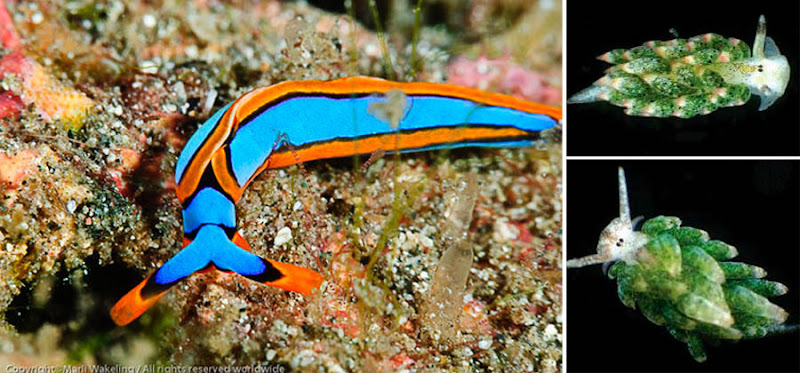
Thuridilla lineolata from Bunaken Marine Park, Sulawesi (shown left):

(image credit: Marli Wakeling, Kathe R. Jensen)

More diversity: Cyerce shown left, and Olea hansineensis from Friday Harbor Laboratories, San Juan Island, Washington: 


So... should humans also learn the trick and start "vegetating"?

By now, after hearing about very "stressful" life this creature lives - think about turning green, sunbathing, swimming in energy - you may wonder if one day humans might not develop technology that would turn us into extremely efficient photosynthesis machines? 

According to Proceedings of the National Academy of Sciences (via):

"Chloroplasts only contain enough DNA to encode about 10% of the proteins needed to keep themselves running. The other necessary genes are found in the algae's nuclear DNA. So the question has always been, how do they continue to function in an animal cell missing all of these proteins? It seems that the algal gene in E. chlorotica's sex cells could be passed to the next generation. Other animals are able to harness sunlight after eating plants, but this is only because they acquire entire plant cells, which is very different to transforming an animal cell into a solar-powered plant-animal hybrid."

"It is unlikely humans could become photosynthetic in this way... Our digestive tract just chews all that stuff up - the chloroplasts and the DNA"

Former Crimson Tide football star Javier Arenas surveys whats left of the street where he lives after tornadoes swept through Tuscaloosa in April 2011. The tornadoes killed 50 people, including six Alabama students. A year later, the people are still recovering emotionally and physically, says SI’s Lars Anderson.
X85946 TK1
CREDIT: Simon Bruty

bomb plot


The Justice Department says five men have been arrested in a plot to bomb a bridge outside Cleveland, according to an AP source.
For more on this story, go to http://usat.ly/ImvDxf.

hot tuesday


Yankees-Red Sox game that was postponed 4/22 at Fenway will be made up as opener of split day-night doubleheader on July 7 at 12:35 pm ET.

playboy

cancer

teeth

naked really

meet the man

seven days

God Tuesday morning

John 11:40 Then Jesus said, "Did I not tell you that if you believed, you would see the glory of God?"

God Tuesday

John 3:18 Whoever believes in him is not condemned, but whoever does not believe stands condemned already because he has not believed in the name of God's one and only Son.